
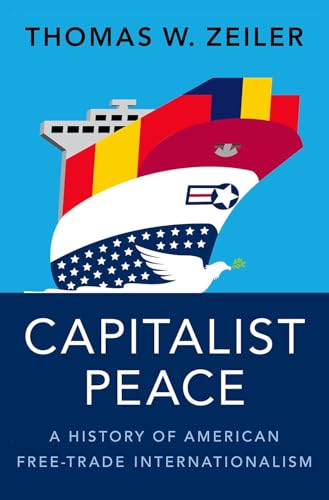
Capitalist peace : a history of American free-trade internationalism / Thomas W. Zeiler.
Material type: TextPublisher: New York, NY : Oxford University Press, [2022]Description: x, 370 pages : illustrations ; 25 cmContent type:
 - text
- unmediated
- volume
- 9780197621363
- 382 ZEI/T
- HF1455 .Z453 2022
| Item type | Current library | Collection | Call number | Status | Notes | Date due | Barcode |
|---|---|---|---|---|---|---|---|
 Books
Books
|
MES KC LIBRARY HISTORY | Social Science | 382 ZEI/T (Browse shelf(Opens below)) | Available | GL42R2 | 43988 |
Includes bibliographical references (pages 287-358) and index.
"The United States pursued free trade from the Great Depression onward as part of its grand strategy of coordinating resources and policies to achieve long-term diplomatic objectives. Ever since Franklin D. Roosevelt's administration, which launched a trade policy steeped in an liberal internationalist worldview, the United States linked trade to global prosperity, to winning wars and peace, and to shaping the world order. Free trade was a cornerstone of an ideology of "capitalist peace." That concept placed trade liberalization in service to political internationalism. By pursuing freer commercial exchanges, capitalist peace ideology knitted trade to national security imperatives and political causes. To be sure, capitalists sought a particular type of global trade, just like communists did and fascists before them. But capitalists harnessed the market, rather than using the state, through free trade. Leaders believed that free trade advanced private enterprise and thus the cause of capitalist peace, which, in turn, promoted prosperity, democracy, security, and attendant by-products like development, cooperation, integration, and human rights. In so doing, the capitalist peace paradigm - with a core of liberal internationalist principles that were ever changing to meet new circumstances and pressures - projected US power, interests, and values into the international arena even as capitalism brought both positive and negative results to the global order. This book shows that free trade internationalism has always been contested - by protectionists in particular but by nations of the global South as well, yet even the skeptics acknowledged the force of capitalist peace thinking"-- Provided by publisher.
There are no comments on this title.